Bamboo | Bananas | Cycads | Evergreen Seedlings | Evergreen Transplants | Hybrid Poplar | Palm Trees | Roses


Welcome to Gator Ventures.com Online Tree and Plant nursery!

We are a family operated tree nursery that was founded on the basis of providing quality trees and plants at afforable pricing. After helping our father establish and grow his tree and plant nursery in Midwestern Wisconsin my brother and I decided to somewhat follow in the family business, just not in Wisconsin. Being that we both migrated and established families in Florida it was decided that we would specialize in growing plants that were suitable for our area.

What started out as growing a few cycads (aka King Sago) from seeds and pups, branched out into growing numerous other palm species. My affection for bamboo and bananas led to us also cultivating these plants. However, after much trial and error growing various species of palm trees and realizing that it could take a lifetime for us to grow a quality sellable product from seed we decided that rather re-inventing the wheel we would do exactly as our father did, which is the simple fact of buying and reselling a majority of our plants until we have enough crop rotation to sustain sales.

This is no different than what any other major retail giant does, however, you will find that buying from us you will get a much higher quality plant. Besides, most major retailers have high school students or other non-skilled workers that are not knowledgable of the plants and trees they sell, and trust me, it shows. Just walk through the garden section sometime and you will see what I mean.

Anyways, we welcome you to navigate the various sections of our website via the menu at the top or bottom of each page. You will find a wide variety of plants, trees, shrubs, flowers, palm trees and more. Our prices are comparably priced to most other online retailers and in many cases we meet or beat the competition. If you desire something that is not listed please feel free to contact us and we will be glad to assist you in your inquiry.

I've also just completed the conversion of the main part of of the site over to a blog format. This will make it easier for me to add articles as well as sharing information about the plants I have to offer, as well as plant care, propagation and more. That part of site starts below, and it should allow me to update the site more frequently. Enjoy!


Plant news, growing tips, information and more....


How To Protect Palm Trees From Freezing

Well winter has spring upon Florida rather quickly this year, bringing freezing temperatures that many of my palms trees cannot handle. Fortunately most of these are in pots, so the easiest fix to prevent them from freezing is bring them into to garage. This not only protects them from the frost but protects them from damaging winds as well, since the radiant heat from the house as well as the lighting in the garage will keep them happy.

Now I'm sure many of you however have planted a palm tree or two that are not as cold hardy, and therefore do not have the luxury of just bringing them in to protect them from freezing. If you are one of these people, here is what I suggest. First, you will need some way to provide heat to your protect your palm. Many people will first string a few strands of Christmas lights both around the trunk of the palm and over or through the fronds. Some even place a floodlight or two and angle them up towards the fronds. After placing your lights the next step would be to drape the palm with some sheets or a light blanket, carefully tying them down or if they are long enough weighting them down with a few rocks or bricks. Using these tips should help keep the ambient air around your palm above freezing, and thus prevent it from both frost damage and freezing.

A word of caution, whatever you do, do not use plastic sheeting on your palm, as this can actually trap moisture underneath which may freeze. Some people also use frost cloth, and it should be applied in the same fashion as stated above. However, in my opinion the added expense is not necessary.

If you are trying to protect a palm from a hard freeze, ultimately what you are then trying to is protect the trunk and heart of the palm, which rests at the top of the trunk where the fronds emerge. On top of the above recommendations, I would also wrap the entire trunk with a heavy blanket. Other suggestions are to surround the trunk with a cardboard box, then filling it with mulch all the way to the top, ensuring that you cover the heart area with a thick layer as well.

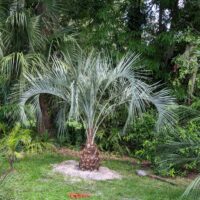
By no means will this necessarily ensure the survival of your palm from freezing temps, especially if you have a palm that is rated for Zone 10 planted in Zone 7, but it will certainly be better than leaving it unprotected. The final suggestion to protect your palm tree from freezing would be to only plant palms that can take sub freezing weather, such as a Butia, Phoenix, Washington or some other cold hardy palm tree.

Oh yeah, for my area of NE Florida they are calling for temps into the low 20's tongiht....brrrrrrrrrrrr!

Growing Bamboo From Seed

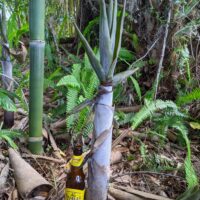
Moso bamboo seedlingGrowing bamboo from seed can be quite rewarding, if you are lucky enough to actually get some fresh bamboo seed.  I say that because bamboo very rarely flowers, and when it does it may do so for several years sporadically until it does a gregarious flowering, after which the primary plant is said to die.  I have witnessed only a handful of bamboo plants producing seed, and even more so only limited germination rate from that seed.  My friend Rich currently has some Bambusa tuldoides in flower, from which he has gotten a few dozen new bamboo seedlings from a few hundred seeds.  A few years ago there was a stand of unknown Multiplex bamboo in St Augustine that was flowering and had tons of bamboo seedlings growing around it as well as tons of seed.  I managed to germinate some of the seed, as well as dig a few seedlings.  However, only a few have survived, of which one of them is now growing in a one gallon pot in my backyard.  In 2008 I tried to do some branch node cuttings from a Dendrocalumus minor amoenus that resulted in the cuttings setting seed rather than rooting.  Unfortunately none of the seed turned out to be viable.

Anyways, the problem with growing bamboo from seed is that it is sporadic.  Bamboo seed is said to lose it's viability quickly unless properly stored or planted immediately.  Another reason is growing environment.  Bamboo seed seems to like a damp growing medium and a little bit of warmth.  This is probably one of the reasons that the mystery Multiplex variety has so many babies growing around it as the mother plant was in a drainage ditch, so it stayed somewhat damp.  The third problem with growing bamboo from seed is loss of seedlings from transplant shock.  Dendrocalamus strictus seedlingsMy brother and I germinated thousands of Moso seeds that we were fortunate enough to get access to.  As the seeds germinated they were transplanted before the primary root go too long into water bottles.  However, much to my dismay it didn't take long for these bamboo seedlings to become root bound in such a small container, and we lost a majority of these before we even realized what was happening.  Chock this up to inexperience.

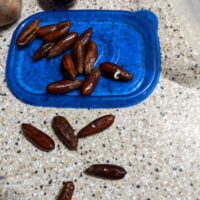
So with that being said, if you are fortunate enough to have some bamboo seed you should germinate it as soon as you possibly can.  Germination rates will vary, and I have some detailed seed germination tips that you might find useful here Bamboo Seed Germination.  I actually use these directions for many of the various seeds I need to germinate, and it works.  If you have a large amount of bamboo seeds you can always try a few different methods to see if you get better results.  The only change to these directions would maybe to use the Jiffy pellets and plant one or two seeds in each pellet, as this will help avoid the transplant shock that I experienced in the past.

How to Propagate Bamboo

Every day people search out information on bamboo propagation and stumble upon my website.  I even get email questions from some of these people asking for additional information.  I'm hoping with the format change of this site that I will be able to share my bamboo propagation information, tips and tricks more easily, as well as propviding an open forum for which people can get their questions answered regarding the subject.

Being there are two types of bamboo, runners and clumpers, the easiest and fastest way to propagate bamboo is through division.  Quite simply this is the act of digging and separating culms from the primary plant.  Runners by far are easiest as the rhizome mass is limited.  Clumping bamboo can be a little more difficult as the rhizome mass is thick, and often requires the use of a sawzall, prybar, shovel and a few gallons of sweat.

The second method of bamboo propagation is through vegetative means.  This method is reserved for the tropical clumping varitety of bamboo and can be accomplished in one or more ways, culm node cuttings, branch node cuttings, whole culm burial and lastly through air layering of branch nodes.  Not all methods work with each type of clumping bamboo either, and some work better for some than others.  Time of year the the cuttings are taken are also a very important factor and vary from species to species.  I'll go into more detail in another post, but if you want you can view some pics of some bamboo I have successfully propagated here Bamboo Propagation Info.

The third method of course is through bamboo seed germination.  Being that bamboo plants do not flower very often makes this one method that many will not see in their lifetime unless they are fortunate enough to get access to fresh seed.  Bamboo seed loses it's viability rather quickly unless stored properly, but I have had success with germinating Moso bamboo seed after several years in cold storage with a germination rate around 50%.  For more on bamboo seed germination, you can see my pictures and detailed instructions here Bamboo Seed Germination.

The fourth method of bamboo propagation which is still in early stages of development and is probably the most difficult is  through tissue culture.   This mass production of bamboo seems to be the fastest way to get the most plants, however, many bamboo experts have found bamboo grown from tissue culture to be problematic when it comes to growth rate and bamboo development.  I have zero experience when it comes to this, but I know there have been many headlines regarding this, and I'm sure as the technology develops it will become a more viable solution to bamboo propagation.  If you are an amateur bamboo propagator I suggest you try out a few of the above methods before attempting tissue culture propagation.